


Derby Lightweight (Yellow Diamond) 1, 2 & 4-car DMUs
North Wales

Two sets passing along the side of the River Conway in the Conway Valley.
The North Wales Part 1 scheme would be allocated seven twin sets. Allocated to Llandudno Junction depot, these were intended for Llandudno - Blaenau Ffestiniog (introduced March 1956) and Gaerwen - Amlwch services (introduced in May 1956).
In the summer months they also operated a Rhyl - Llandudno "Welsh Dragon" express service, and other services in the area such as to Bangor. This seasonal traffic meant the allocation fluctuated greatly, growing in the summer (at one time the depot had 36 Derby Lightweight vehicles allocated) and shrinking in the winter months. They would also occasionally operate on other services and many excursions.
They continued to be allocated to the area until January 1965, when they were replaced by Blue Square vehicles.
The vehicles
In February 1955 the British Transport Commission approved six twin sets for Blaenau Ffestiniog - Llandudno Junction and Gaerwen - Amlwch service, at a cost of £145,830, along with £4,000 for the provision of maintenance facilities and fuelling installations.[1]
This old diagram sheet shows the numbers allocated to those six sets:
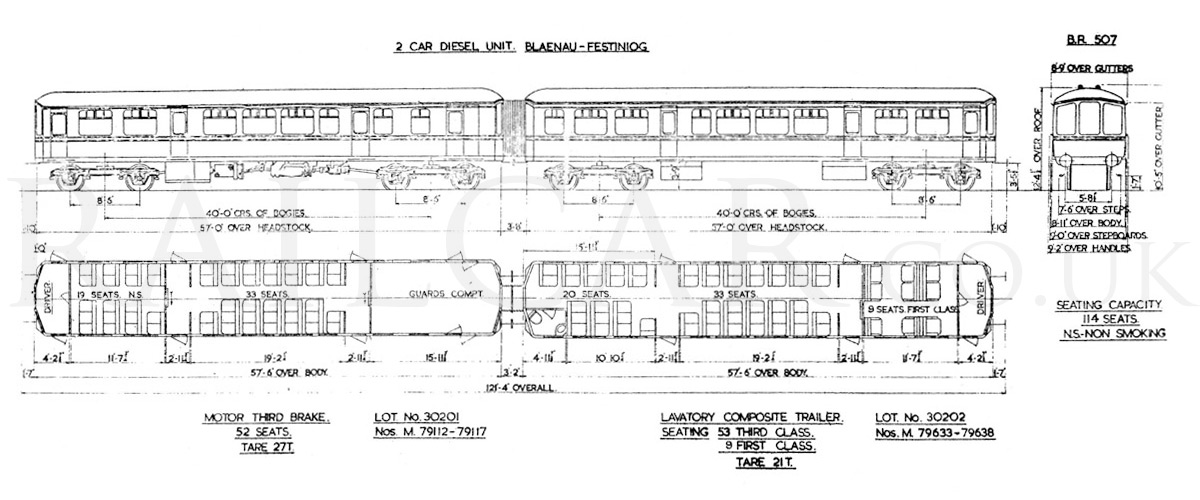
| Number | Type | Lot. No | Seats | Weight |
|---|---|---|---|---|
| 79112 - 79117 | DMBS | 30201 | 52 | 27t |
| 79633 - 79638 | DTCL | 30202 | 9 / 53 | 21t |
At the 8/9th February 1956 meeting of the Diesel Lightweight Trains Committee it was noted that the British Transport Commission had approved an additional two-car set (minute 424/1). By this time, the numbers 79118 and 79639 had been allocated to other builds — so, to keep all seven vehicles numerically together, the seven sets would become M79143-9 and M79663-9.
| Number | Type | Lot. No | Diagram | Seats | Weight |
|---|---|---|---|---|---|
| 79143 - 79149 | DMBS | 30201 | 633 | 52 | 27t |
| 79663 - 79669 | DTCL | 30202 | 642 | 12 / 53 | 21t |
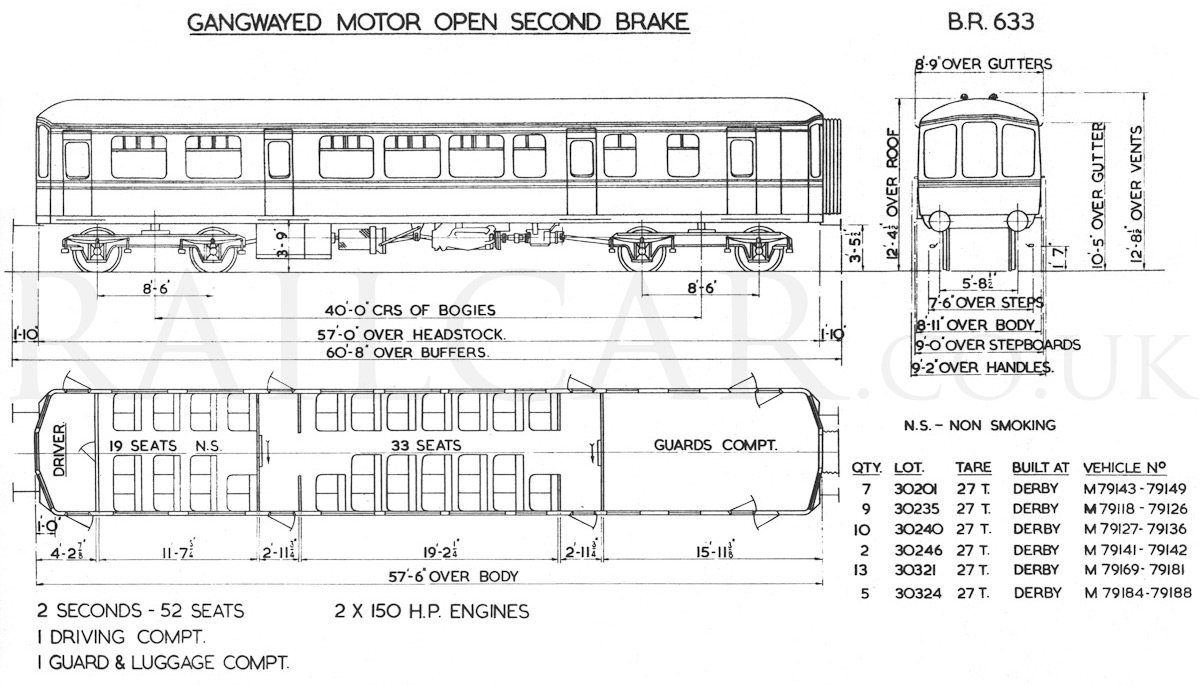
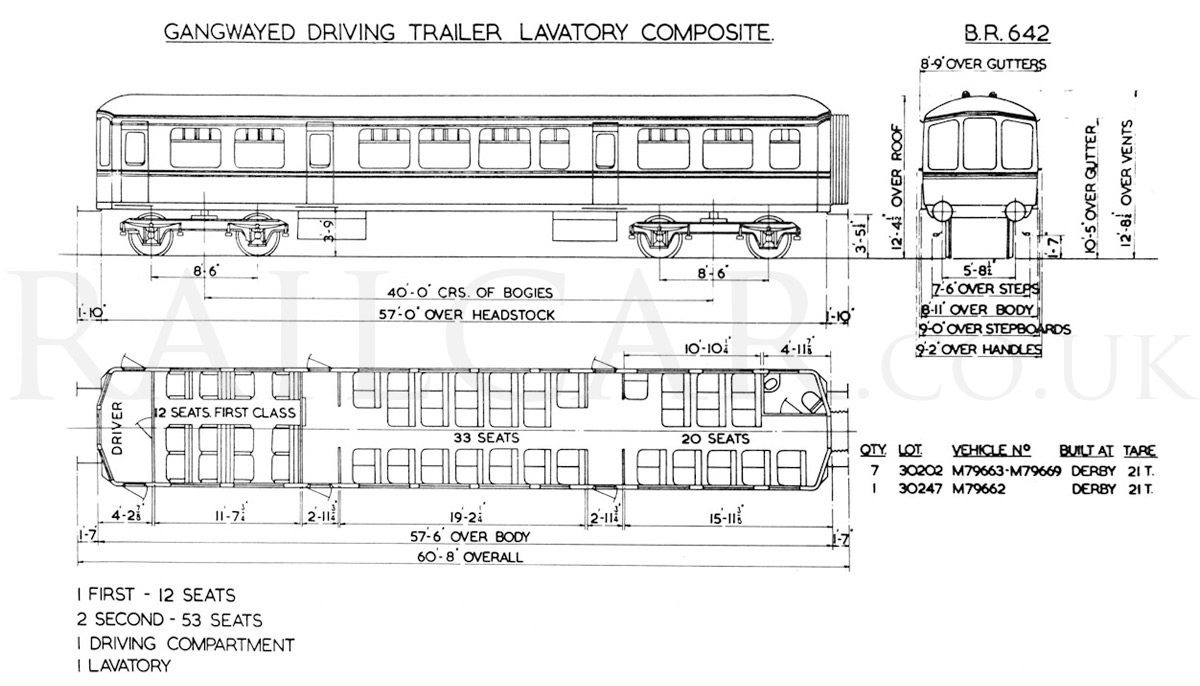

M79143 in Blaenau Ffestiniog North station.
However, these would end up being delivered to Monument Lane, and only two of those sets would spend a short time allocated to Llandudno Junction M79143/7, and trailers). At some point, the vehicles allocated to the North Wales scheme changed to become M79130-6 with M79651-7. They were built just after M79143-9, despite the lower numbers, this was probably to let crew training begin in Birmingham sooner. M79130-6 were vehicles originally intended for the Manchester - Styal service, as part of the Manchester Part 1 scheme, changes there due to electrification plans made the vehicles available.
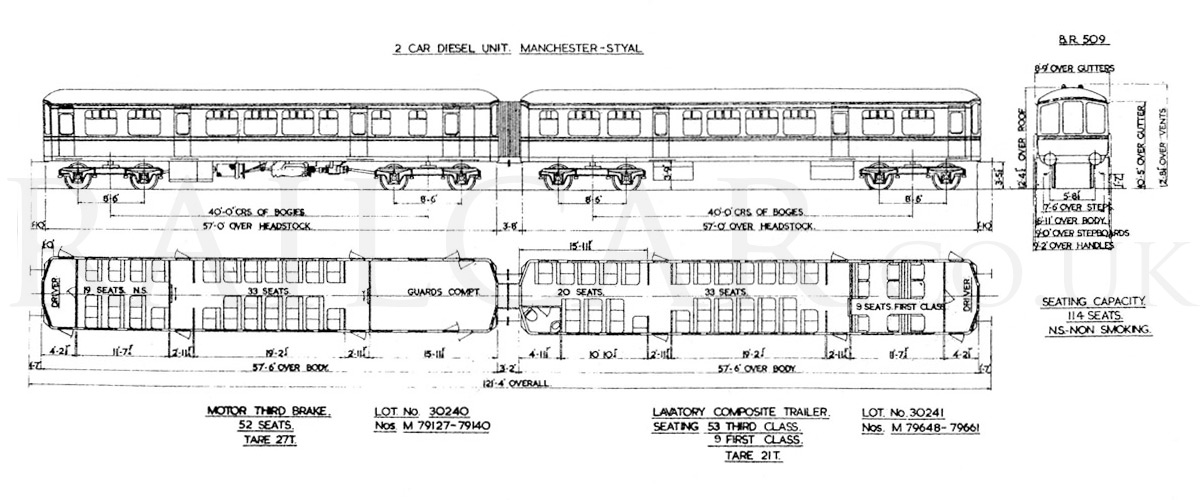
Again, plans changed. The Birmingham Part 1 scheme was launched the same day as the North Wales Part 1 scheme, with the Birmingham scheme a bigger priority. Two of their sets were on loan to West Cumberland to help out there, and so the dieselisaton of the Amlwch branch was deferred, and two North Wales sets went to Birmingham to cover. While all the seven sets were allocated to Llandudno at some point, only M79133-6 with M79654-7 of the seven became long term residents, from May 1958 till January 1965, although some already spent time at the depot prior to the May 1958 arrival.
The only others that spent any real time allocated to Llandudno Junction were the five power twins M79184-8 + M79185-93 which had all spent brief periods at the depot in the first few years, but from late 1959/early 1960, these would stay for five years until the final days of the type at Llandudno. Three of the DMCLs (M79191-3) were converted to driving trailers as M79633-5 in 1962.
All the sets were based at Llandudno Junction depot, shed code 6G, and two roads of the carriage shed were reconstructed for their servicing.[2]
1956
Deliveries
In January 1956 Lightweight sets began arriving at Llandudno Junction for crew training[3]. The first sets were M79124 + M79645 and M79143 + M79663, borrowed from the Birmingham Part 1 scheme. For the start of that service, five sets intended for North Wales, M79130-4 + M79651-5, went new to Monument Lane[4].
The first set recorded as being allocated to Llandudno Junction was M79135 + M79656, new to the depot on 3rd March 1956, followed a week later by M79136 + M79657 on the 10th. M79143 + M79663 and M79147 + M79667 would be transferred to the depot in April from Monument Lane.
Llandudno - Blaenau Ffestiniog Services Begin

A set in Betws-y-Coed station circa mid-1956.
DMUs were introduced to the regular service between Llandudno and Blaenau Ffestiniog on Monday 5 March 1956.

A folded leaflet was made available to the public to promote the new trains. This is the front page (right) and back page (left), the inside is not shown.
During the 1956 Easter Holidays (Easter Sunday was 1st April) sets M79135/79656, M79136/79657, M79143/79663 and M79147/79667 were noted working in the North Wales area.[5]
Amlwch

A set on an Amlwch service at Bangor on 19 September 1956.
The introduction of DMUs to the Bangor - Amlwch service had originally been planned to start at the same time as the Ffestiniog service, but demands for DMUs elsewhere in the Region meant that their introduction was delayed until 28 May 1956.
On this route there would also be Amlwch - Gaerwen and Gaerwen - Bangor trains.
The set for the Amlwch branch left Llandudno Junction the previous evening with the 11.15pm all stations to Bangor, where it was stabled overnight. After completing the day’s work, it returned from Amlwch at 7.13pm to Bangor and went forward at 8.36pm to Llandudno Jct.[2]
The Welsh Dragon

Two set at Colwyn, heading to Llandudno, on 1 July 1956 — likely a Welsh Dragon service although no sideboards are carried.
The Diesel Lightweight Trains Committee had investigated the use of DMUs on this service, and at their November 1955 meeting it was agreed that two two-car sets should be allocated to this service for the summer season, using units from the Manchester (Part 1) scheme.
The Lightweights used on service carried sideboards (at least in the summer of 1956) but no headboard. Using two 2-car sets for this service resulted in a temporary shortage of sets, and consequently the 2.00pm from Llandudno to Betws-y-Coed and the 4.06pm return (both SX) were steam worked. At the time, in addition to the Blaenau Ffestiniog turns the sets worked local trips to Bangor (on Sundays) and one return trip to Pwllheli.
The “Welsh Dragon” which had been running as a 6-car, was reduced to four cars at the end of August 1956. On the 4th September it was comprised of three power cars and a trailer.[2]
Summer Vehicles
By July, the allocation of Derby Lightweights to Llandundo Junction had swollen to 34 vehicles, forming 15 twins and 2 power twins. All were new to the depot except M79143/7 and M79663/7 which had came from Monument Lane. Many of these sets were transferred to Longsight depot circa September ready for services to start there.
Other services
On 28 July, 4 August and 11 August 1956, the 7.08am Llandudno - Birkenhead and 10.00am return were formed of three sets.[6]

On 11 August 1956, the 10.30am (SO) Prestatyn - Manchester Exchange and the 1.30pm (SO) Manchester Exchange - Llandudno were worked by sets 79136/77/84 (presumably with their trailers) instead of the normal Mold Junction Stanier 2-6-0 — this was the first recorded use of North Wales sets to visit Manchester.[6]
When the summer 1956 holiday traffic diminished, 6-car sets were used on Sundays to work special excursions in the LMR "See Britain By Diesel" series, picking up at principal stations between Llandudno and Chester. “The Peak” ran on the 2nd September to Buxton (formed of 79178/80/4 + trailers), followed by “The Lakes” to Windemere the following Sunday, and “The Shakespeare” to Stratford-on-Avon on the 16th[2]. The single sided handbills measured 6 ¼" x 10".

1957
In January 1957 M79136 + M79657 went on loan from Llandudno Junction to Monument Lane, where services on the Lichfield City - Four Oaks - Birmingham New Street line were being strengthened to handle an increased number of passengers since petrol rationing[7]. The move would become permanent, but they would be transferred back to Llandudno Junction in June 1958 when Monument Lane became a fully Blue Square depot.

A set alongside Fowler 44525 in Blaenau Ffestiniog station.
By June 1957 all Llandudno sets had yellow diamonds painted on the lower cab fronts to represent their coupling code.[8]
Summer Vehicles
In June a number of sets arrived from Longsight depot to help with the summer services, Llandudno Junction now having 36 Derby Lightweight vehicles — the highest it would achieve (and repeated in Summer 1958). This was short lived, in July 12 vehicles moved to Monument Lane, at the same time five GRC&W twins were delivered new to Llandudno Junction.
Auto Gear
In mid-1957 power car M79135 was fitted with experimental auto-gear changing equipment.

Six Llandudno sets (79173/4/5/8/9/80 and 79674/5/8/9/80/1) were loaned to Birmingham to strengthen Birmingham New Street - Lichfield services during the World Scout Jamboree between the 1st and 12th August 1957.[9]
The end of summer excursions ran again, including “The Lakes” to Windemere on September 1st. As Llandudno Junction now had blue square sets, it's unclear whether Derby Lightweights worked these.
In December excursions from Llandudno included to Shrewsbury, Wolverhampton and Birmingham on the 8th, and Longport, Etruria and Stoke on Trent on the 15th.
1958

A set heads to Llandudno after passing Llandudno Junction.
Winter vehicles
While summer 1957 saw the depot have the highest number of Derby Lightweight vehicles, January 1958 saw the lowest (until the type ended their time on North Wales in 1965). The departure of power twins M79186/8/9/93 to Blackpool in January left just 7 vehicles at the depot — power twin M79187/92, and two twins with a spare trailer (M79126/47 and M79647/67/83). The depot also had a Park Royal and five Cravens twins.

The two ex-Llandudno power twins, along with an Upperby power twin (M79185/90), arrived at Blackpool on 17/1/58 for two weeks crew training before working a Preston - Blackpool service from the 1st to 8th February. This was in connection with Blackpool’s “Small Gifts and Fancy Goods Fair”. During that week of operations, Lancaster drivers were trained on the DMUs as sets were due to work the Lancaster - Morecombe - Heysham line during forthcoming engineering work.[10]
The sets continued to be used on excursions, the image shows the cover of a folded handbill listing those in March, a similar one was issued for April.

The summer 1958 timetable for The Welsh Dragon is shown, the opposite side of the 6 ¼" x 10" handbill promoted the Conway and Lledr Valley diesel services.

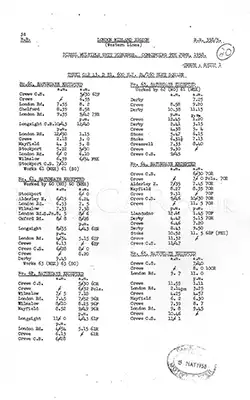
The summer 1958 timetable, introduced on 9 June, involved diagrams for 12 sets. To cover these duties, and to have spares and maintenance coverage, a number of sets arrived from Monument Lane, released by a large amount of three-car Class 101s and a few Class 104s transferred to Birmingham to replace the yellow diamond vehicles.
These nine pages are an incomplete set of diagrams for the Western Lines operating area, page four to nine cover the Llandudno Junction sets with services to Bangor, Amlwch, Blaenau, Carnarvon, Pwllheli and Rhyl.
PDF Download (1.7mb).
1959 — 1964

A twin set, M79132 closest, at Llandudno Junction circa 1959.
In December 1959 and January 1960 six twin sets departed Llandudno Junction for Reddish depot. The vehicles were M79128-32 + M79654-7, they had spent a year and a half allocated to North Wales, and an ex-Upperby set M79125 + M79646 that had arrived in May 1959.
They would be replaced by the five power twins (vehicles M79184-93) which arrived between November 1959 and February 1960 from Speke Junction. This would be the final allocation change for the Derby Lightweights allocated to Llandudno Junction until September 1964. After almost four years with a greatly fluctuating allocation, for the final (almost) five years it would be stable with 18 vehicles, the five power twins (M79184-8 + M79189-93) and four twins (M79133-6 + M79654-7).
In 1962, three of the DMCLs (M79191-3) were converted to driving trailers as M79633-5, adjusting the sets to two power twins and seven twins. Another event involving the power twins in 1962 was when M79185 suffered a broken axle on 22 July 1962 when working a Blaenau service near Pont-y-Pant.

One of the DMBSs from the power twins didn't make it to 1965 with the others — M79188 was involved in a collision (details unknown, circa autumn 1964) damaging the cab, and it would be withdrawn in December 1964. It is pictured in the sidings at Bangor after the incident.
Probably due to the above accident, a twin set (vehicles M79011 + presumably M79603) were reallocated from Carlisle Upperby to Llandudno Junction in September 1964.
Passenger services on the branch between Amlwch and Gaerwen ended in December 1964.
1965 — the final year
On the first day of 1965 Llandudno Junction depot had an allocation of 19 Derby Lightweight vehicles: 11 power cars and 8 trailers (including the three converted from power cars), which would form seven twins, two power twins, and leave a spare trailer (due to the withdrawal of M79188). The depot also had several Blue Square sets, one Met-Camm and three BRC&W twins.

Former North Wales vehicle M79633 leads a set arriving into Claydon station with an Oxford service on 4 September 1965.
That month a further four Met-Camm twins arrived, two from Ryecroft and two from Chester, allowing the depot to shed its Yellow Diamond allocation. The West Cumberland set 79011 + 79603 returned to Carlisle, the others moved to Bletchley.
At Bletchley, along with a set from Watford and one from Reddish, they began working on the Oxford and Cambridge services, releasing the Blue Square Derby Lightweights (Class 108s) on that service to move to Chester.
They remained at Bletchley until 1967/8, after which they moved on to Norwich, Carlisle Upperby, Leith Central, or were withdrawn.
This film from The Huntley Film Archives has a fascinating trip across north Wales including interior and cab views, and the West Cumberland set 79011 + 79603 at 9:57.
References
- ⋏ BTC Works & Equipment Committee Minute 369 of 23/2/55.
- ⋏ a b c d p289 October 1956 Railway Observer
- ⋏ "Talking of Trains", p135 April 1956 Trains Illustrated
- ⋏ p99 April 1956
- ⋏ p133 May 1956 Railway Observer
- ⋏ a b p259 September 1956 Railway Observer
- ⋏ p68 March 1957 Railway Observer
- ⋏ p194 July 1957 Railway Observer
- ⋏ p257 September 1957 Railway Observer
- ⋏ p72 March 1958 Railway Observer
The Railway Observer is the journal of the Railway Correspondence and Travel Society