


Class 105/6 Cravens 2 & 3-car DMUs
Modifications
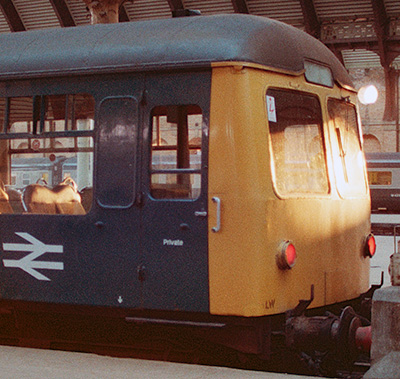
Bounce Panels
Some Eastern Region vehicles, mainly those intended for the M&GN lines in Lincolnshire and Norfolk — routes that were single lines under token operation, had a rubber panel added just behind the drivers door on both sides. This was to protect the bodywork (and no doubt the passengers who'd be alarmed by a loud bang) during token exchanges on the move, when the tablet would swing back and hit the body.
When first added they were self-coloured - white or maybe a light grey. When vehicles were repainted the panels would also be painted in the body colour, as seen in the image of E51299 at York by Jonathan Hazen.
These panels were also fitted to other DMU types in East Anglia.
Re-engining
Allistair Taylor notes that "cars 50370/1 had Leyland engines when built but were converted to AEC ACX220s at some time early in their careers. This may have been done at Hull Springhead works when the inspection hatches where put in, if memory serves the Leyland cars did not have these when withdrawn."
AWS
Eastern Region sets were noted as being fitted with AWS around May 1961. One such set, 51269/56427 had to be removed from the 20:03 Kings Cross - Hertford North on 11 May 1961 due to dragging brakes. It was noted in traffic shortly afterwards with the AWS equipment removed.[1]
Tripcock Equipment

London sets would be fitted with tripcock equipment, needed to run over the widened lines to Moorgate. In the image can be seen part of this, a vacuum pipe with isolation cock to the leading bogie.
Radiators
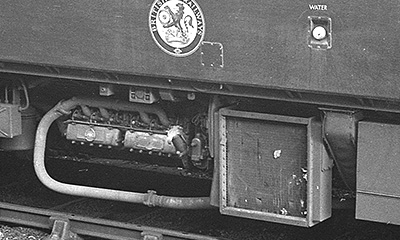
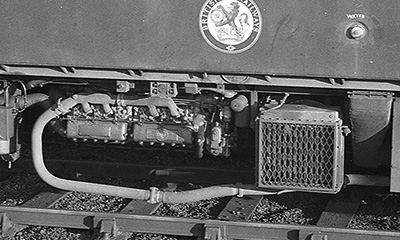
At some point a number of ER power cars were fitted with a larger radiator. This is shown in the first image. A standard radiator is shown in the second image for comparison.
Note also the different arrangements of the water (coolant) filler on the bodyside.
Both images were taken in October 1967.
Route Indicators
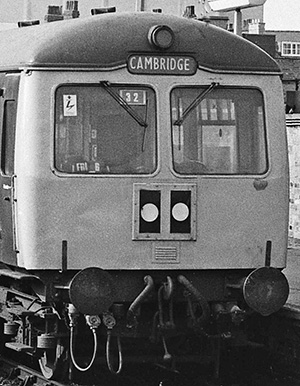
At least two vehicles (50371 and 56127) had a different style route indicator in the blue livery 'domino' (white dot) era, presumably after accident repairs. 50371 is shown in the image.
In the same images of these two vehicles, the circular plates over the lower outer marker lights are missing, possibly the lower cab fronts have been completely replated.
Once the route indicators were no longer used there were a variety of random style found. Some had the blinds wound to white, some had two white dots on black in place of the blinds, some had them painted over in yellow, some were crudely plated over. In time many were properly plated over, and by 1982 all units left in service carried just the two marker lights.
When new in the lower centre of the cab end there was an air intake grille. Over the years these could be seen with smaller grilles, moved off-center, or removed and the area plated over.
Window Bars

In the late 1970s vehicles allocated to Newcastle had bars fitted to passenger doors for use on lines with restricted clearances.
Exhausts
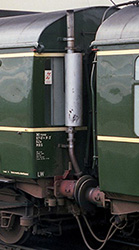
In time, many power cars would be modified to the normal style of external pipes — rising either side of the gangway.
Stratford Headlamps
Circa 1981 several Stratford allocated vehicles had two headlamps fitted adjacent to the marker lights. These vehicles included at least 50362, 50363, 50364, 50366, 50369, 56122, 56133, 56421 and 56422. The image shows headlamp fitted 54421 at Romford on 13-7-84. On Tour With the Class 13 Army.
One vehicle — 53361 — ran for several years with wires coming out the cab where these headlamps would have been (as seen in this image) but I have not found any images showing it with headlamps so it may have had the work on adding them started then abandoned.
By 1985 the lamps were removed but the brackets were left in place.
References
- ⋏ p230 July 1961 Railway Observer (Railway Correspondence and Travel Society)